

How Does the FCA Regulate Stablecoins? UK Classification and QCDD Rules

The UK’s new cryptoasset regime takes effect on 25 October 2027. Whether an asset needs a Qualifying Cryptoasset Disclosure Document (QCDD), and what that document must contain, depends on how the asset is classified. Stablecoins are treated in one of three ways, depending on whether they are qualifying stablecoins and whether they are issued by a UK-authorised issuer.
What is a QCDD?
A QCDD is a disclosure document that sets out the information material to a person considering buying or subscribing for a qualifying cryptoasset. It is the UK’s functional counterpart to the white paper under the EU Markets in Crypto-Assets Regulation (MiCA). The two regimes differ materially in structure and requirements.
This article focuses on classification and updating. For what a QCDD must contain, how qualifying cryptoasset trading platforms (QCATPs) review it and who is liable for it, see our guide, QCDDs Explained: What the FCA’s New Crypto Disclosure Rules Require.
Which cryptoassets fall within the QCDD requirements?
The UK framework starts with a classification question: is the asset a qualifying cryptoasset? Only qualifying cryptoassets need a QCDD.
A cryptoasset is qualifying where it is fungible and transferable. Fungible means that units of the asset are freely replaceable by others of a similar kind, so a unique token does not qualify. Transferable means that the asset, or the rights it confers, can be passed to another person. Assets that are merely a record of value or contractual rights are not qualifying either, nor are those excluded as electronic money, currency, specified investments or restricted-use tokens.
In practice, conventional cryptocurrencies such as Bitcoin (BTC) or Ether (ETH) are qualifying and need a QCDD. Non-qualifying cryptoassets, such as certain NFTs and non-transferable loyalty points, are not subject to the QCDD requirements.
Stablecoins need a closer look.
How are stablecoins classified?
Qualifying cryptoassets include stablecoins, but not every stablecoin is a qualifying stablecoin. That status depends on a separate legal definition, which requires assets to be held for the purpose of maintaining a stable value in relation to a fiat currency. An algorithmic stablecoin such as Basis Cash (BAC), for example, may qualify as a cryptoasset without meeting that definition. A stablecoin that does not meet that definition is treated like any other qualifying cryptoasset, with an ordinary QCDD.
Qualifying stablecoins then divide into two groups:
- UK qualifying stablecoins: issued by a UK-authorised issuer carrying on the regulated activity of issuing qualifying stablecoins from the UK.
- “Non-UK” qualifying stablecoins: qualifying stablecoins that do not meet the definition of a UK qualifying stablecoin, including those issued by firms without the relevant UK authorisation, or issued outside the UK rather than from a UK establishment..
We use “non-UK” for convenience. It is not a separate legal classification. A qualifying stablecoin that does not meet the definition of a UK qualifying stablecoin remains a qualifying stablecoin. The same stablecoin, such as USDC or tGBP, can fall into either group, depending on the issuer's UK authorisation and where the asset is issued from.
The split here follows the issuer. A UK qualifying stablecoin issuer is already subject to more extensive FCA regulation, so its QCDD is more flexible. Where the issuer is not UK-authorised, the ordinary QCDD applies, with additional disclosures and a prominent warning that the stablecoin is not issued by a UK-authorised person. The table below shows how each type of cryptoasset is treated.

How do disclosure requirements differ for UK and non-UK qualifying stablecoins?
Two qualifying stablecoins can face substantially different requirements.
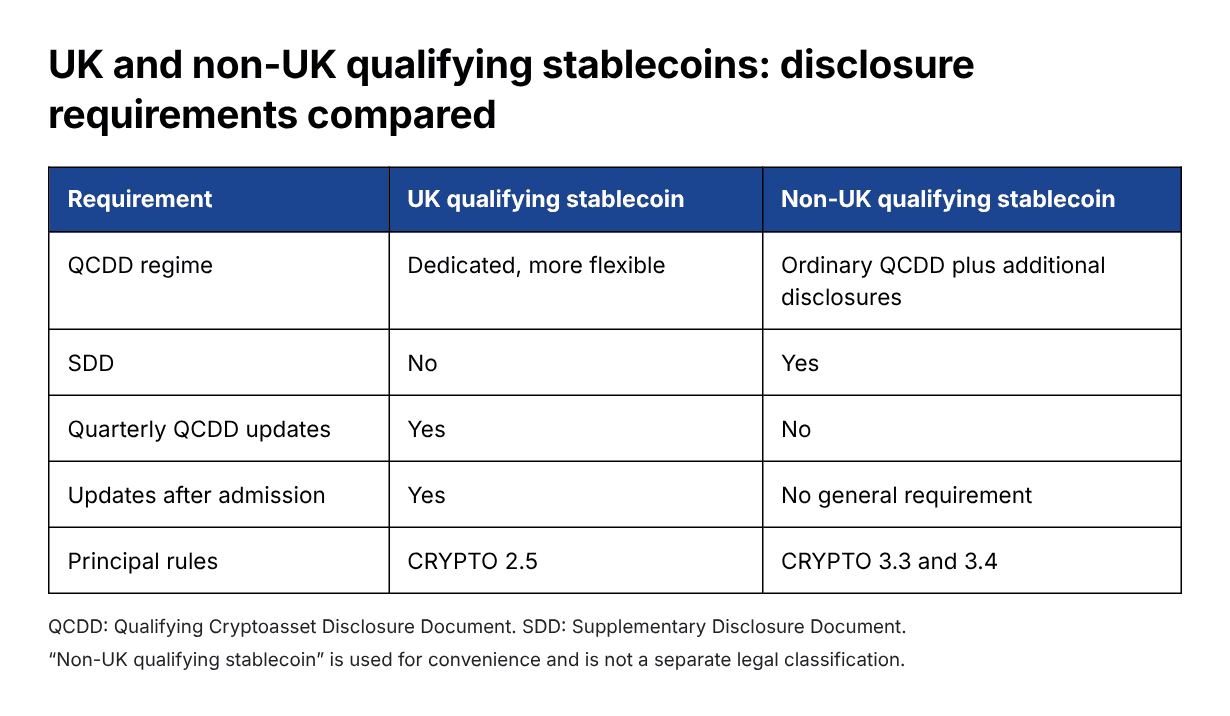
UK qualifying stablecoins follow a dedicated QCDD regime under FCA CRYPTO 2.5, and are expressly carved out from the general QCDD rules in CRYPTO 3.3 and 3.4. These documents benefit from greater flexibility over their content. CRYPTO 2.5.42G recognises that stablecoin QCDDs need not contain the same information in all cases as other QCDDs, because UK qualifying stablecoin issuers are already subject to more extensive FCA regulation
Non-UK qualifying stablecoins follow the ordinary QCDD regime, with three additional disclosure requirements:
- Stabilisation mechanisms: Regulation 13(1)(c) requires information about the mechanisms designed to maintain the asset’s stable value, including the holding and management of backing assets and the application of algorithms.
- Issuer information: Regulation 13(1)(d)(iv) requires disclosure of matters relating to the stablecoin issuer that may affect the asset’s price or value.
- Regulatory status warning: CRYPTO 3.4.7R requires a prominent statement informing readers that the stablecoin is not issued by a person authorised in the UK to issue stablecoins.
The first two requirements concern substantive information rather than prescribed statements. They apply where relevant under the general disclosure framework. A non-UK qualifying stablecoin QCDD is therefore largely an ordinary QCDD with stablecoin-specific disclosures.
How do QCDD updates differ across cryptoasset categories?
The answer depends on the category of the asset.
Ordinary qualifying cryptoassets, including non-UK qualifying stablecoins, use the Supplementary Disclosure Document (SDD). If a significant new factor arises, or a material mistake is identified, after publication but before admission to trading, an SDD is required. The original QCDD remains unchanged, and the SDD provides the additional information.
After admission, there is no general FCA obligation to keep updating the QCDD. The disclosure requirements apply again, however, where the asset is subsequently admitted to another QCATP. To see how SDD triggers and buyer withdrawal rights work in practice, read QCDDs Explained.
UK qualifying stablecoins take a different approach. Their issuers must update the QCDD at least once every three months under CRYPTO 2.5.48R. Relevant inaccurate information must also be corrected in accordance with CRYPTO 2.5.49R. SDDs do not apply. The issuer updates the QCDD itself, which is closer to MiCA's approach to white paper amendments, where the original disclosure document is replaced by an updated version.
What should issuers settle first?
Classification comes first. It decides what a QCDD must contain and how it is updated, so it should be settled before drafting begins.
The UK regime does not treat stablecoins alike: two stablecoins with the same function can carry different disclosure content and different update obligations, depending on how they are classified and who issues them.
Three questions settle it. Is the asset a qualifying cryptoasset? If it is a stablecoin, does it meet the legal definition of a qualifying stablecoin? And is its issuer UK-authorised? The answers decide what the QCDD must contain and how it is kept current, whether through quarterly updates or a supplementary document before admission.
________________________________________________________________
From asset classification and drafting compliant QCDDs or stablecoin disclosures to managing QCATP due diligence, pre-admission SDDs, and quarterly updates, our team of UK cryptoasset compliance specialists helps issuers and admission applicants navigate the FCA’s regime without unnecessary friction.
Contact our specialists today to map your token’s classification and prepare for a smooth admission process.


