Our Tools
Regulatory intelligence, built for the MiCA ecosystem
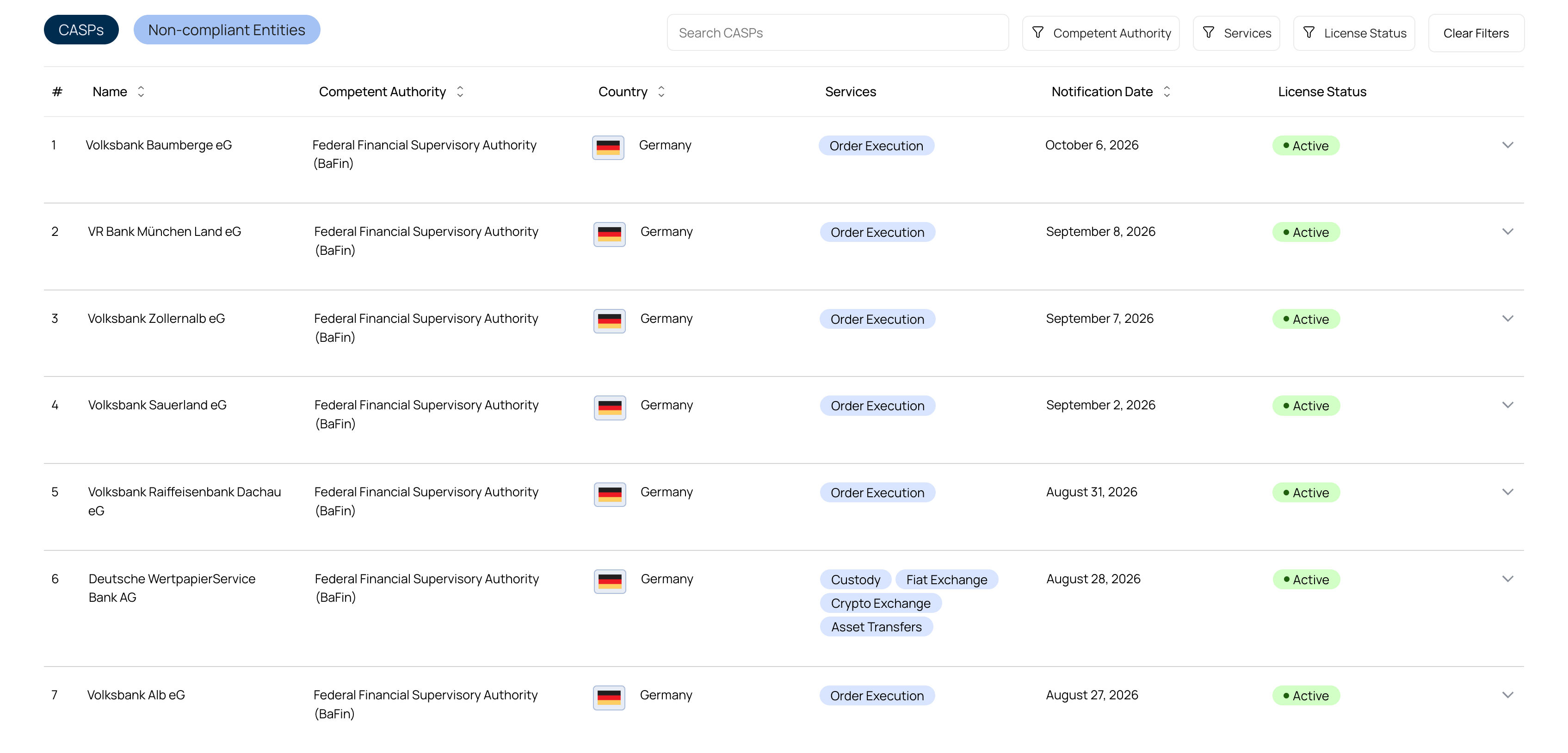
The Alliance has developed open tools that transform complex regulatory information into structured, searchable and actionable intelligence. Our team continuously monitors public regulatory data, reviews official disclosures and organises information into resources that help issuers, CASPs, regulators, researchers and market participants understand the evolving digital asset regulatory landscape.
1100+
White Papers Tracked
550+
MiCA Disclosures Published
30+
Sustainability Indicators Tracked

Frequently Asked Questions
The EU’s Markets in Crypto-Assets (MiCA) Regulation (EU 2023/1114) is the European Union’s first comprehensive legal framework for crypto-assets. It establishes harmonised rules for the issuance, trading and custody of digital assets across all EU Member States. MiCA applies to asset-referenced tokens (ARTs), e-money tokens (EMTs), crypto-assets other than asset-referenced tokens and e-money tokens (OTH) and crypto-asset service providers (CASPs) such as exchanges and custodians. Its goals are to improve legal certainty, enhance investor and consumer protection, promote innovation and ensure financial stability across the EU’s digital asset market.
MiCA applies to natural and legal persons in the EU that issue, offer to the public or seek admission to trading of crypto-assets and to crypto-asset service providers (CASPs) such as exchanges, trading platforms and custody providers.
In scope:
- Offerors of crypto-assets to the public in the EU.
- Persons seeking admission to trading of a crypto-asset on a trading platform.
- Issuers of ARTs and EMTs. CASPs, including operators of trading platforms and custody or administration services.
White paper responsibility:
- Before a public offer or admission to trading of crypto-assets that are not ARTs or EMTs, a crypto-asset white paper must be drawn up, notified and published by the offeror or the person seeking admission.
- Operators of trading platforms must ensure that, where a white paper is required, a compliant white paper has been drawn up, notified and published before admission. The operator itself may also adopt the role of person seeking admission to trading.
- CASPs need ESG data and also often white paper links even when they do not offer a trading platform
MiCA establishes a single, harmonised framework for crypto-assets across all EU Member States, replacing the patchwork of national regimes. It introduces clear rules for disclosure, conduct and governance, enabling CASPs to operate throughout the EU under a single authorisation passport.
By setting consistent standards for white papers, risk disclosure and consumer protection, MiCA aims to increase legal certainty, market integrity and investor confidence. Projects that fail to comply, for example by not publishing a MiCA-compliant white paper or by misrepresenting risks, may face regulatory enforcement, delistings or trading restrictions.
Compliance under MiCA builds trust, transparency and cross-border market access, strengthening the overall credibility and stability of Europe’s digital asset ecosystem.
MiCA is now fully in force across the European Union.
Since 30 June 2024, MiCA has applied to ARTs and EMTs.
Since 30 December 2024, MiCA’s rules have applied to all other crypto-assets, including utility tokens and CASPs
While MiCA is fully applicable, many Member States have adopted national transitional or “grandfathering” periods that allow existing CASPs to continue operating temporarily under prior national regimes while they apply for MiCA authorisation.
These national transition windows began on 30 December 2024 and ended between 30 June 2025 and 1 July 2026. Currently, all grandfathering periods have ended and MiCA-compliant authorisation is fully mandatory for continued operation.
A MiCA white paper (crypto-asset white paper) is the core disclosure document required before a public offer or admission to trading of a crypto-asset in the EU. Under MiCA, white-paper obligations apply to crypto-assets other than ARTs and EMTs (OTH), as well as to ARTs and EMTs. These are governed respectively under Title II (OTH), Title III (ARTs), and Title IV (EMTs) of the Regulation. For Title II assets, the content is set by Article 6 (with details in Annex I) and the format and templates by Commission Implementing Regulation (EU) 2024/2984.
A MiCA white paper provides comprehensive information on:
- The issuer or offeror and its legal identity
- Rights, risks and governance linked to the crypto-asset
- The underlying technology and safeguards for users
- Sustainability disclosures, as specified in Commission Delegated Regulation (EU) 2025/422, where applicable
Before any offer or admission to trading, the white paper must be notified to the competent authority (at least 20 working days before publication for OTH crypto-assets) and published on the offeror’s publicly accessible website in accordance with MiCA.