

Two Sessions, One Question: What the Rules Mean for Institutions at MERGE Madrid

Two rooms in Madrid, one question. How much of what institutions can do with digital assets is decided by technology, and how much by the rulebook?
MERGE Madrid ran from 27 to 29 October across the Madrid Stock Exchange and Palacio de Cibeles. The organisers describe it as bringing together more than 3,000 attendees and over 200 speakers from crypto, digital assets and Web3. Juan Ignacio Ibañez, Executive Director of the MiCA Crypto Alliance, took part in two sessions that came at that question from opposite ends: one on Bitcoin, one on stablecoins.
Bitcoin and the institutional question
The first was the DeFi Technologies Capital Markets Series, held on 28 October with Valour and Stillman Digital. More than 25 organisations joined, including European banks, asset managers, investors, supervisory authorities, rating agencies and digital asset infrastructure providers. The afternoon covered deep dives on Bitcoin, Ethereum and Optimism, an introduction to the DVIO Index and a closing panel on products, platforms and investor demand.
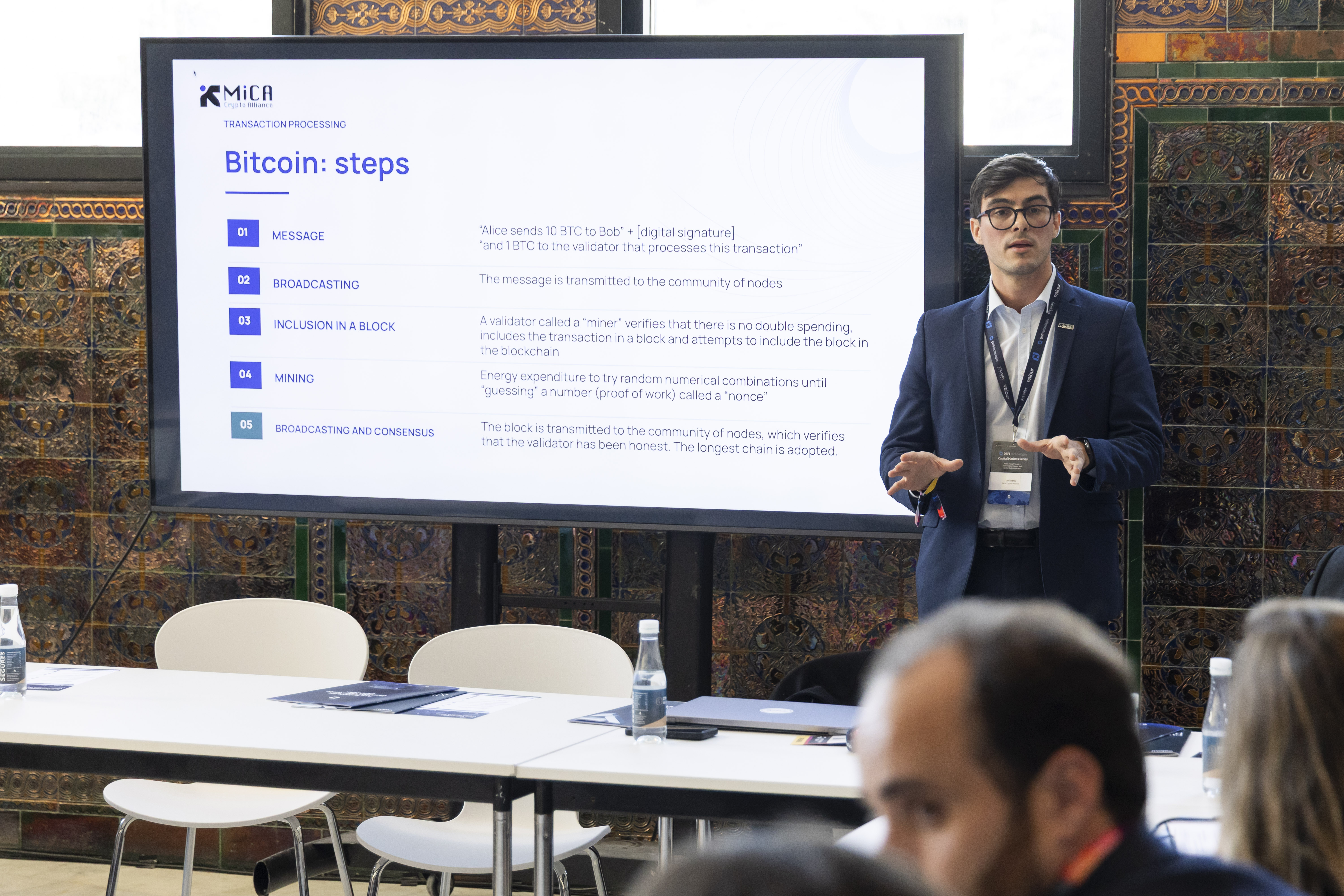
Speakers across the afternoon included Andrea Disarò, Principal, Structured Products & Quantitative Analysis at DeFi Technologies; Andrew Forson, TEP, President of DeFi Technologies and Chief Growth Officer at Valour; Carlos Arena, Vice President of Sales at OP Labs PBC; Guillermo Barco Muñoz, Senior Product Manager Digital Assets at Swissquote; Jacob Lindberg, Chief Revenue Officer at Valour; Mariana de la Roche Wills, Founder & CEO of BlackVogel; Marina Markezic, Co-Founder & Executive Director of the European Ethereum Institute; and Soledad Contreras, Head of Partnerships, EMEA & APAC at CoinDesk.
The Bitcoin deep dive took participants through the architecture, the terminology, the main debates and the fork history. It then asked why institutions are adopting Bitcoin now.
Two kinds of change are part of the answer. The first are changes at protocol level. The second are changes in how the Bitcoin value chain is regulated, from custody to exchange traded products. Participants debated how far each has influenced the shift.

Two stablecoin regimes side by side
On 29 October, the panel “MiCA vs GENIUS Act: One Year On” put the two regimes next to each other on the MERGE Stage at Palacio de Cibeles. Moderated by the Alliance’s Executive Director, it brought together Dr. Justine Scerri Herrera, Founder & Partner at MK Fintech Partners; Carmen Arjona García, Corporate & Digital Assets Lawyer at Asensi Abogados; Desislava Petrova, Senior Supervision Officer, MiCA, at the European Banking Authority; and Carlos Silva António, Regulatory Policy Expert in the Financial Stability Department at Banco de Portugal. That covered supervision, central banking, law and fintech.
A short guide to the terms helps. Under MiCA, an e-money token (EMT) is a stablecoin that references a single official currency. An asset-referenced token (ART) references something else, such as a basket of currencies or other assets. The US GENIUS Act regulates what it calls payment stablecoins.
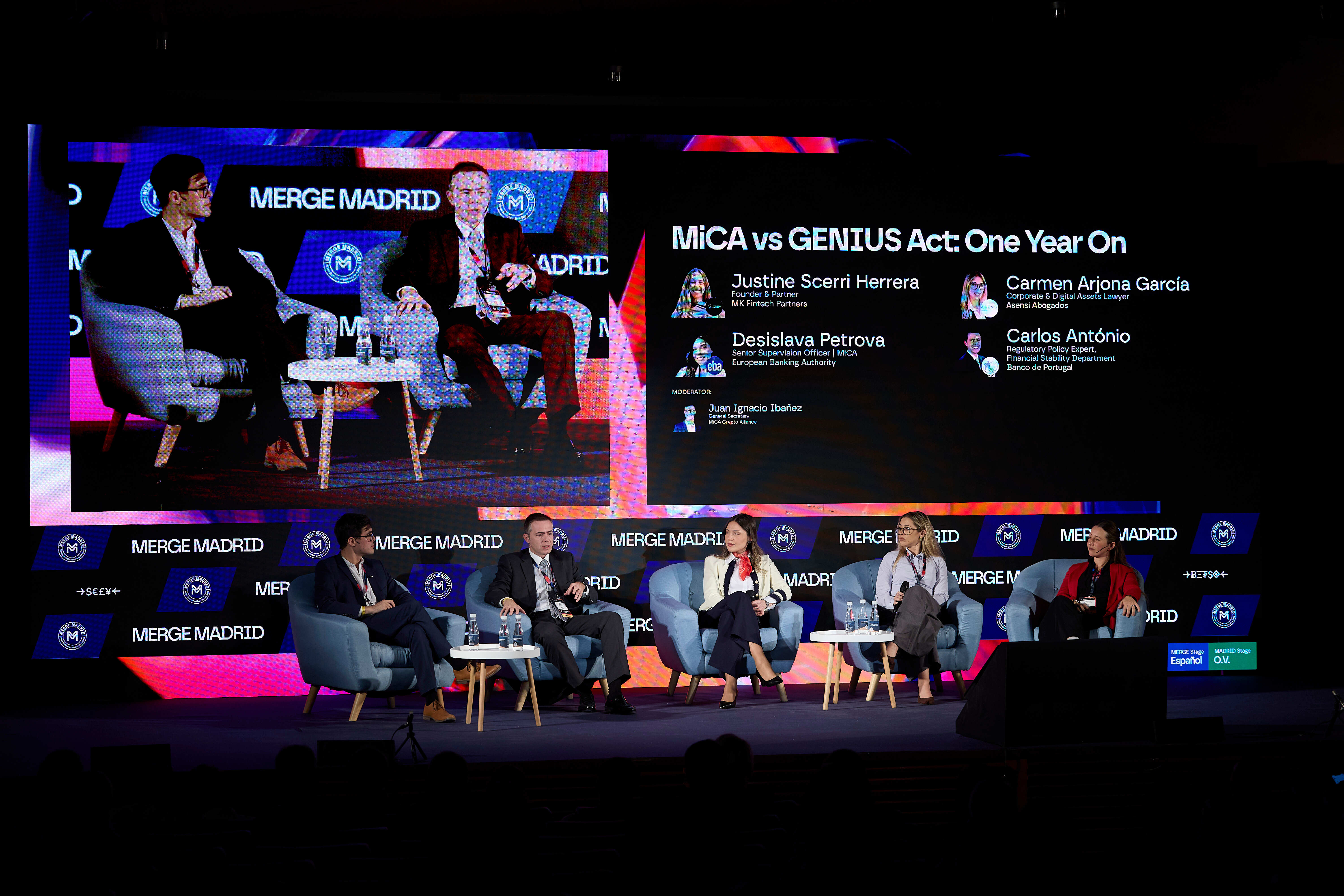
The panel started with the fundamentals. Reserve requirements differ between the two regimes. So do the concepts of a stablecoin. MiCA has multi-currency ARTs and GENIUS does not. The gap also sits in the definitions: a GENIUS payment stablecoin and an EMT are not the same thing. The panel then compared the systemic regimes, meaning the significant EMT category in the EU and its counterpart in the US.
What a year of MiCA stablecoin rules has taught
The panel drew lessons from MiCA’s stablecoin implementation, and two risks came up. The first is liquidity mismatch, which arises when the assets behind a token cannot be turned into cash as fast as holders may want to redeem. The second is bank disintermediation, which arises when customers move money out of bank deposits and into stablecoins, weakening banks’ funding and their role as intermediaries.
Both regimes also sort stablecoin issuers into bank and non-bank categories, each in its own way. The two regimes cooperate and compete at the same time. Whether there is a level playing field between them remained an open question.

Looking ahead
The panel closed on fragmentation and interoperability between stablecoin regimes, with predictions and priorities for the next three years.
Both sessions pointed the same way. What an institution can do depends on how the rules define a product and who may issue or distribute it. For firms working across jurisdictions, those definitions repay a close reading.


