

MiCA Crypto Alliance at UCL: Understanding the Global Crypto-Asset Regulatory Landscape
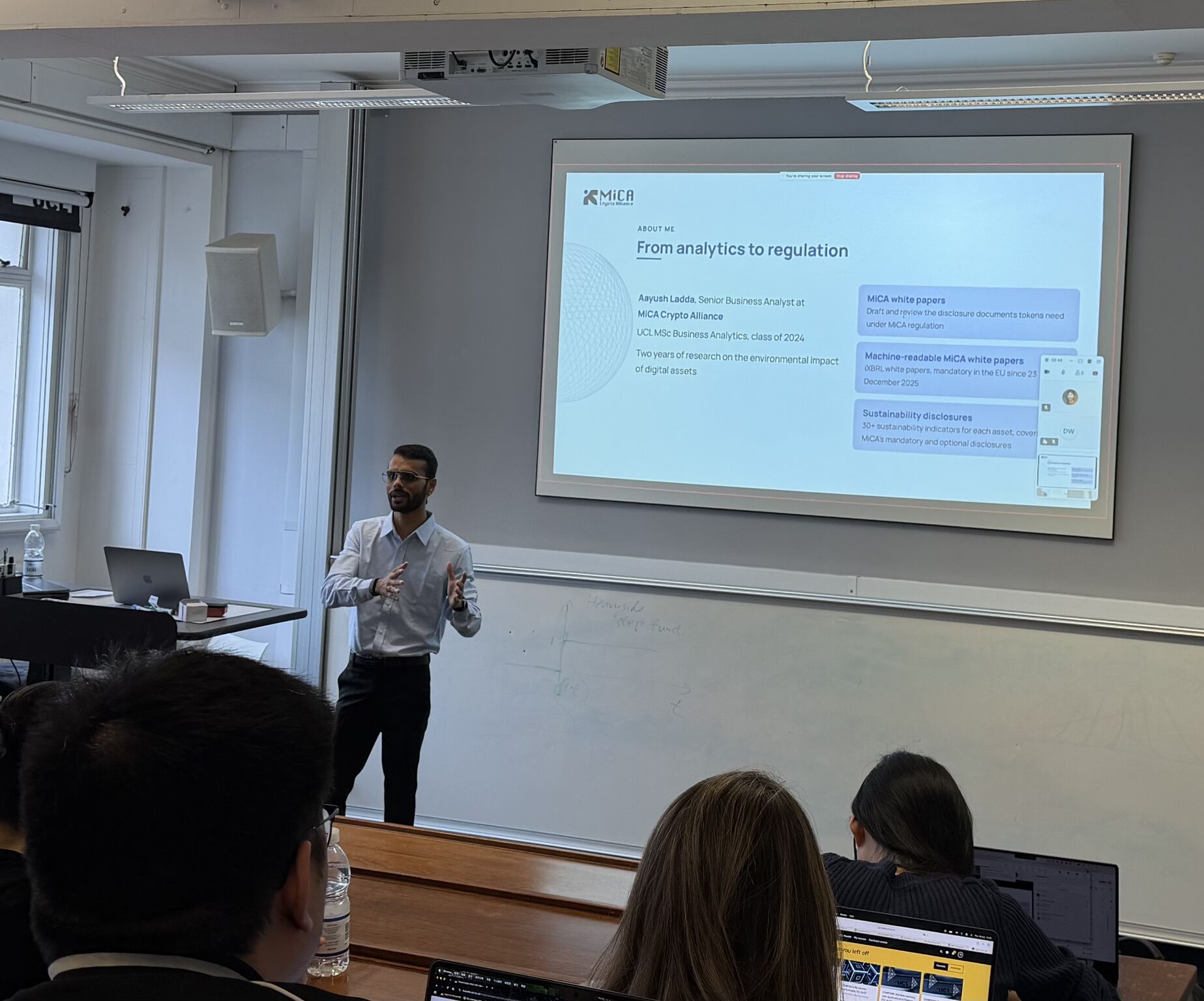
This week, Aayush Ladda, our Senior Business Analyst and a UCL MSc Business Analytics alumnus, presented “Understanding Global Crypto-Asset Regulatory Landscape” as part of the Emerging Topics in Digital Technologies Seminar Series at University College London.
Mt. Gox. Terra. FTX. Each collapse left investors exposed. Each raised the same question: what should regulation have done?
Aayush examined the risks regulation has to address and what meaningful investor protection looks like in crypto-asset markets.
Would you get your money back?
He opened the discussion with a simple test. Only a few hands went up when he asked who had held a crypto-asset. He then asked those people whether they would get their money back if their trading platform failed tomorrow. The room’s answer was mostly no, with one condition: perhaps, if the platform held a licence. That is where regulation comes in. It gives holders security in what he described as a grey zone.
How crypto markets are different
Aayush set crypto-asset markets against traditional ones on five points:
- Trading hours. Crypto markets run around the clock, with no public holidays. Traditional markets keep fixed hours.
- Intermediaries. Traditional markets separate exchanges, brokers, custodians and clearing houses. In crypto, these roles often sit under one roof. Licensing and authorisation rules are now separating them.
- Issuers. A share has an identifiable issuer. A stablecoin does too. Bitcoin does not.
- Borders. Crypto set out to solve cross-border payments. Traditional markets are bound by national borders.
- Identity. Traditional platforms verify who their customers are. A crypto wallet is only an address.
Do these differences change what the markets do? Not at their core. Traditional finance and crypto both transfer value from one place to another. So the principle Aayush set out is that both should be regulated in similar ways.
Five failures, five gaps
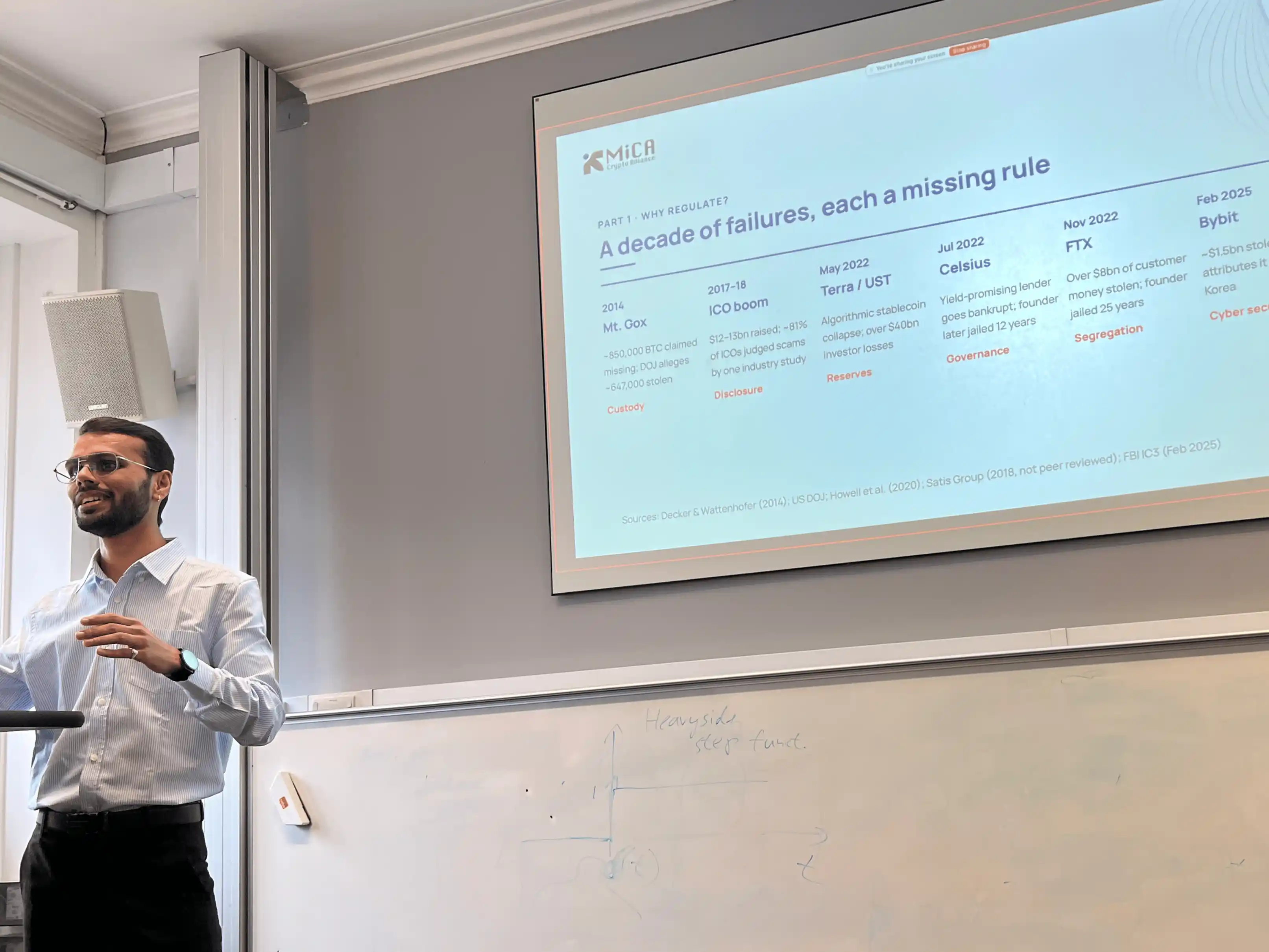
What should regulation have done? Aayush answered with five cases, each tied to a gap.
The first three were failures of basic assurance. Mt. Gox, the Tokyo-based exchange, collapsed in 2014 after about 850,000 bitcoins were lost, and there was no proper accounting of what it held in custody. The ICO boom of 2017 and 2018 showed a similar lack of visibility from the investor’s side. Projects raised vast sums and vanished, and no disclosure documents explained what their tokens were for. Terra followed in 2022. Its algorithmic stablecoin, UST, was meant to hold a one-to-one peg to the US dollar, yet no actual reserves stood behind it. When selling pressure arrived, the peg broke and the coin collapsed.
The last two cases moved from what firms promised to how they were run. FTX passed the money investors put into the exchange to its sister company, Alameda, and nothing kept the two apart. Bybit, in 2025, was different again. About $1.5 billion was stolen in a cyber attack that took only minutes. Aayush called cybersecurity the biggest threat to the industry as its value grows. Taken together, the cases gave him five reasons for regulation mattering: custody, disclosure, reserves, segregation and security.
From risks to rules
The presentation then turned to the EU’s Markets in Crypto-Assets Regulation (MiCA), covering token classifications, licensing and passporting. Aayush set it against the UK’s developing framework and the wider global landscape.
The session with a question: whether holders would get their money back if their platform failed tomorrow. Where custody, disclosure, reserves and segregation are left unchecked, the answer is no. Regulation is how the answer changes.
—--------------------------------------------------------------------------------------------------------------------------------------------------------
Thank you to the UCL team for hosting the seminar: Tomaso Aste, Giuseppe Destefanis, Wei Chen, Nikhil Vadgama and Jiahua Xu, with UCL Computer Science, Financial Computing and Analytics, University College London and UCL Engineering.
Investor protection starts with clear rules and clear disclosure. What are you working toward? Whether you need a MiCA white paper, UK QCDD support, ESG verification or membership, we can help. Tell us where you’re working on, and we’ll tailor a solution to fit. Contact us


