

The Grandfathering Clock: Where MiCA's Transitional Periods Stand as 1 July 2026 Approaches
In an exact month from now, the single most important date in MiCA's transitional architecture arrives. On 1 July 2026, the maximum 18-month grandfathering window under Article 143(3) closes across every Member State that opted for it. For a large share of the EU and EEA, the bridge from the old national VASP regimes to full MiCA authorisation simply ends.
This is the last and largest of a staggered series of cut-offs that has been running since mid-2025. We track each one closely, because every expiry tells us something about how a jurisdiction is actually coping, not how it said it would cope on paper.
What "grandfathering" is, precisely
MiCA's CASP regime became applicable on 30 December 2024. Article 143(3) gives providers that were already offering crypto-asset services lawfully under national law before that date a transitional period in which to keep operating while they apply for, and await a decision on, a CASP authorisation. The clause sets a hard ceiling of 1 July 2026 (i.e. operation through 30 June 2026), but it lets each Member State shorten or waive the period where it considers its pre-existing national framework less strict than MiCA, provided it notified the Commission and ESMA by 30 June 2024.
The result is not a single deadline but thirty different ones. And three points are routinely missed:
- Grandfathered providers are not licensed CASPs. They cannot pass through the EU. Cross-border activity must continue to rely on existing national permissions, only in jurisdictions that still apply their own transitional regime.
- Some obligations were never grandfathered at all. MiCA's market abuse provisions (Title VI) and the Transfer of Funds Regulation applied from day one.
- The protection was always conditional. Most Member States set an application deadline, a date by which a complete authorisation request had to be filed to keep the benefit of the transition. For the majority of the EU, those filing deadlines have already passed. The headline expiry date is the end of the runway, not the start of it.
The state of play, May 2026
By the start of this year the windows had already closed in roughly half of the thirty jurisdictions. The remaining cohort, dominated by the countries that took the full 18 months, expires at the end of June.
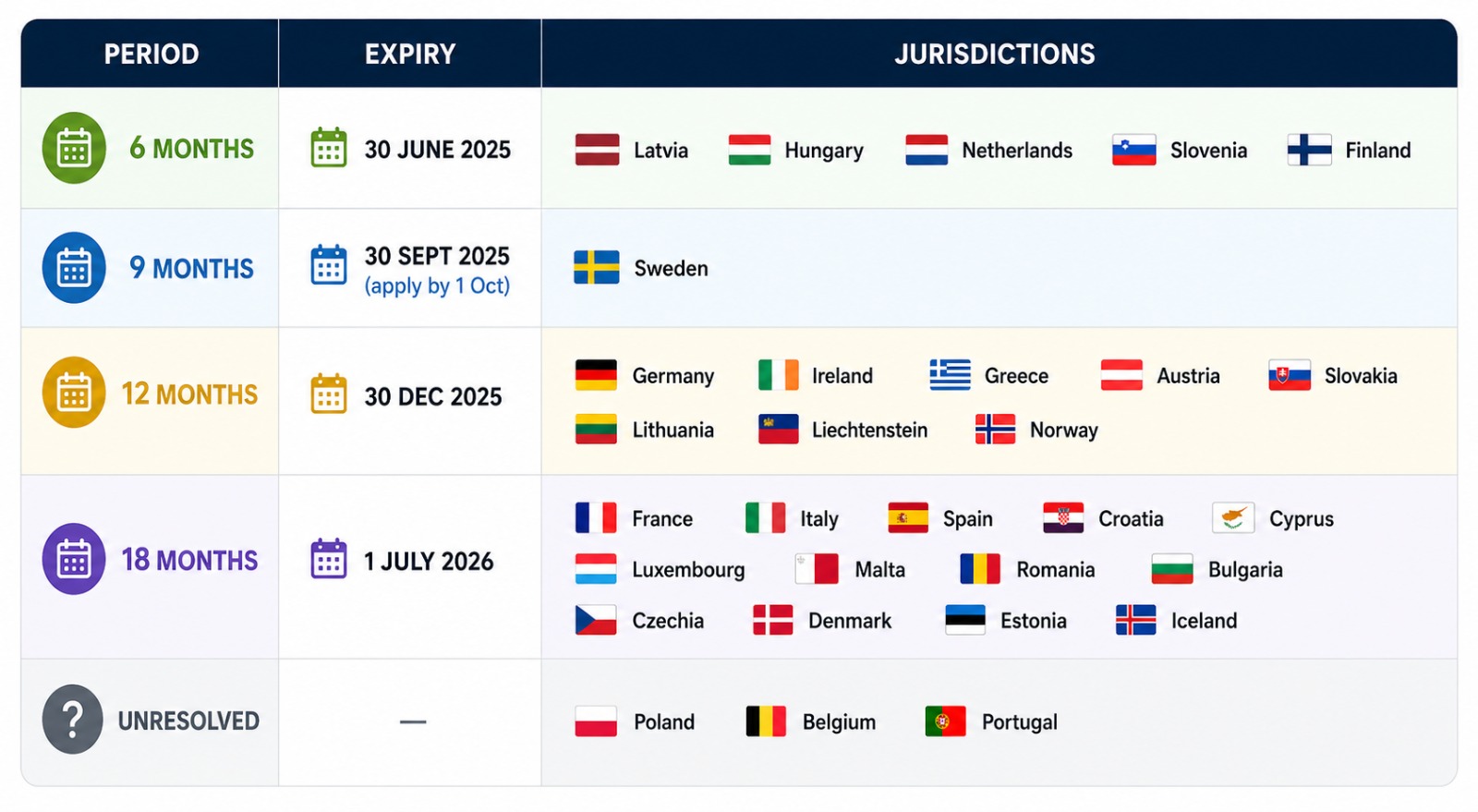
A few entries have moved since the periods were first notified, which is exactly why a static list is not enough:
- Spain extended from 12 to 18 months in ESMA's 1 December 2025 update, pushing its cut-off from year-end 2025 to 30 June 2026, a deliberate move to relieve the year-end "cliff edge" and give the CNMV more runway on pending files.
- Bulgaria and Italy earlier lifted their periods from 12 to 18 months; Lithuania moved the other way, settling on 12 months and closing on 31 December 2025.
The original concern behind tracking these deadlines was never the orderly cases, it was the jurisdictions that would arrive at their own deadline unprepared. Poland is now the clearest example.
ESMA's list records Poland at six months, but Poland has still not enacted the national legislation needed to run the regime. Successive versions of the Crypto-Assets Market Act cleared the Sejm and were vetoed by the President, in December 2025 and again in February 2026, with attempts to override the veto falling short. A further version passed the Sejm in mid-May 2026 but is not yet law and may face another veto. The practical effect remains a regulatory vacuum: there is no designated National Competent Authority to receive or decide CASP applications. The KNF's position is that registered Polish VASPs may continue until 1 July 2026, but because no authorisation can currently be granted, they risk losing any lawful basis to provide crypto-asset services from 2 July 2026 if no competent authority is in place by then. Operators are left to authorise elsewhere in the EU and passport in, wind down, or wait on a legislative process that is still unresolved.
Belgium and Portugal remain in a different kind of limbo, having never formally announced a transitional period at all.
ESMA's 4 December 2025 Statement on MiCA Transitional Measures set the tone for the final stretch. Entities relying on the transition that do not yet hold a CASP authorisation are expected to have orderly wind-down plans in place, and national authorities are told to scrutinise last-minute applications rather than wave them through. Continuing to provide services after a period closes, without authorisation, is enforcement territory.
So as each window shuts, the question for that market is concrete: is the regulator authorising in time, granting a pragmatic extension, or facing a cliff edge with firms stranded mid-application?
The divergence is the story
Grandfathering is where MiCA stops being a regulation on paper and becomes an operational reality, unevenly, country by country, on dates that have already shifted more than once. Each expiry is a data point on how prepared a Member State really was, and the divergence between them is itself a competitive and supervisory story worth following.
The MiCA Crypto Alliance monitors these deadlines as they fall, flags movements in ESMA's list against what national authorities are doing in practice, and surfaces the cliff-edge cases early. We'll be marking the 1 July 2026 expiry as it arrives, and watching closely how the jurisdictions that took the full window, and the ones still without a framework, handle the moment the bridge comes down.
Source basis: Regulation (EU) 2023/1114 (MiCA) Article 143(3); ESMA's published list of grandfathering periods and its December 2025 Statement on MiCA Transitional Measures; national competent authority communications. Some notified periods were not all formalised in national law at the time of notification and remain subject to change, and the figures above reflect the position as of 28 May 2026.


